
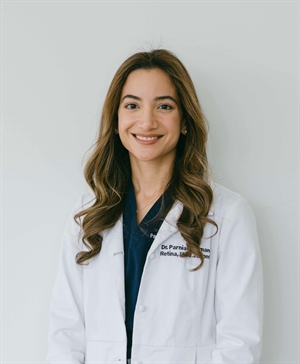
Parnian Arjmand, MD, MSc, FRCSC, DABO, FASRS
Mississauga Retina Institute
1420 Burnhamthorpe Rd. E., Suite 415
Mississauga, ON L4X2Z9
Canada map
(905) 232-0674 office
(905) 232-7722 office
Professional Affiliations
Academic Appointments- Lecturer (adjunct), University of Toronto, Department of Ophthalmology and Vision Sciences, Toronto, Ontario, Canada.
- Assistant clinical professor, School of Medicine, Toronto Metropolitan University, Toronto, Ontario, Canada.
- Baycrest Health Sciences Centre
Education and Training
- Retinal fellowship
- University of Toronto, Toronto Western Hospital/Department of Ophthalmology, Toronto
- Ophthalmology residency
- University of Ottawa, Ottawa, Ontario, Canada
- Medical School
- McMaster University, Hamilton, Ontario, Canada
- College
- University of Toronto, Toronto, Ontario, Canada
Biography
Dr. Parnian Arjmand is a retinal specialist and vitreoretinal surgeon based in Mississauga, Ontario, Canada.
Her clinical practice focuses on medical and surgical diseases of the retina and vitreous, with particular interest in macular disorders and complex retinal surgery.
Passionate about medical education, Dr. Arjmand is actively involved in teaching and mentorship, including supervision of trainees and delivering focused, competency-based teaching for medical students and residents.
Dr. Arjmand maintains an active academic profile with outputs spanning clinical education, retina research, and knowledge translation. Her recent scholarly and educational work includes post-operative imaging characteristics after macular hole repair, safety considerations in anti-VEGF therapy, and national-level educational content development on retina therapeutics such as biosimilars. She also has a strong interest in AI-enabled retinal imaging research, particularly applications involving OCT feature extraction and clinically meaningful biomarkers.
Her clinical and surgical interests include macular hole repair, epiretinal membrane surgery, retinal detachment repair, diabetic retinopathy and retinal vascular disease, complications of cataract surgery (including dropped lens management), secondary intraocular lens techniques, and optimizing peri-operative outcomes through imaging-guided decision-making.